
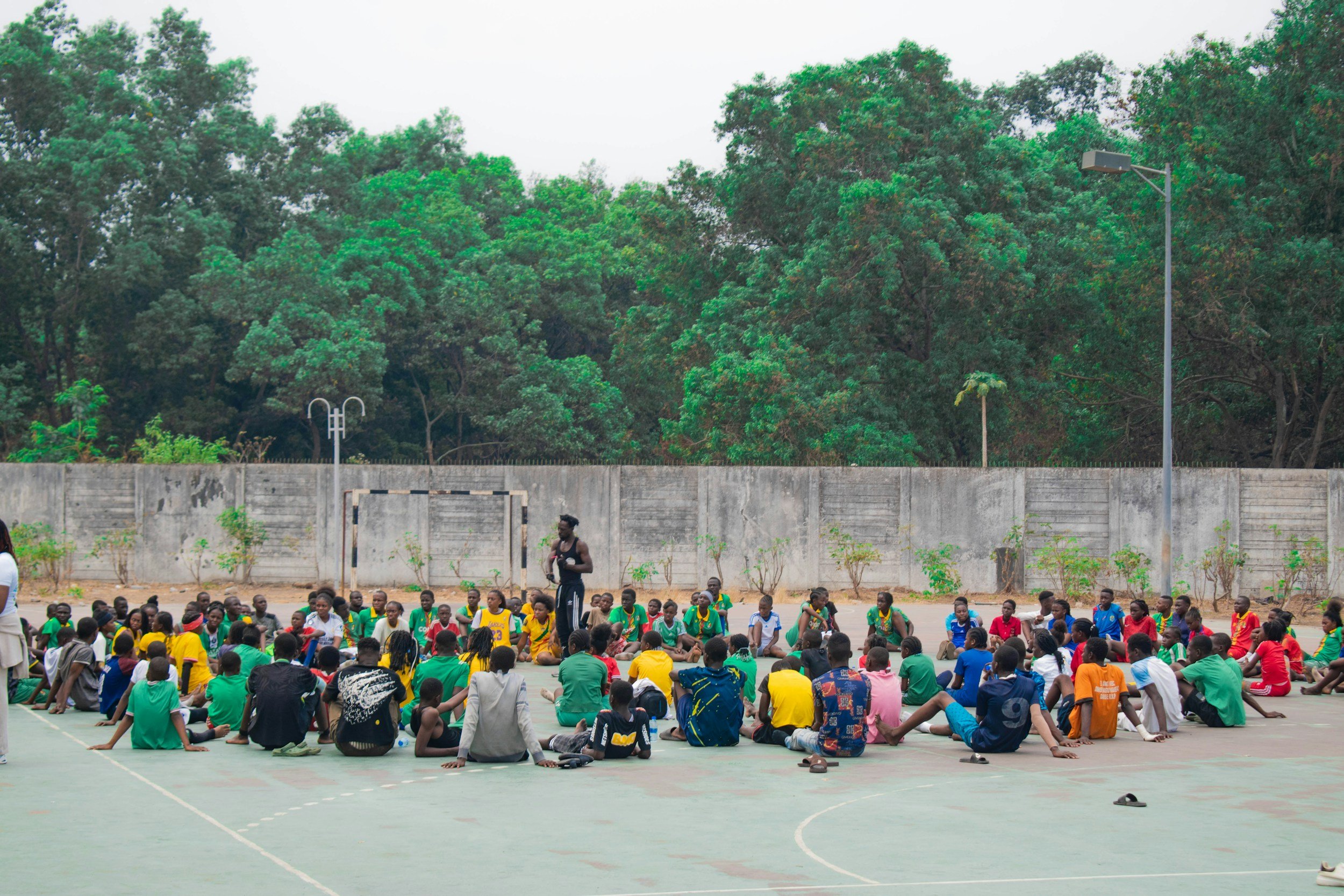
Most research on pedagogical models follows a familiar script. A university researcher designs an intervention, recruits a school, and checks how faithfully teachers deliver it. On a recent episode of Playing with Research, Dr. Ash Casey of Loughborough University talked through a paper that flips that script. “Shifting the Culture of Physical Education: Teachers and Students’ Experiences of Models-Based Practice” is open access in Physical Education and Sport Pedagogy. It documents what happened when an English secondary PE department decided to rebuild its curriculum around models-based practice (MBP) on its own terms.
The department led, the researcher followed
Ash didn’t go looking for a school. During COVID, a head of PE was given rare space to rethink the curriculum. They read widely, decided to try something different, and contacted him. His role was that of a critical friend: pointing to resources when asked and making introductions, but not directing the work.
He did talk them out of their first plan, which was to roll out models across every year group at once. Six models across five year groups is roughly thirty units of work for novice model users, which he felt, and advised was potential a fast route to not be using models in a few months.
The department’s design was clever. Each teacher was assigned one model to researched. They then wrote the unit, and taught their colleagues how to use it. The units slotted into the existing curriculum rather than replacing it. The result looked a lot like a jigsaw classroom (Risto’s description), where everyone was responsible for one piece and dependent on others for the rest.
The teachers started talking about what they were teaching and asking whether they could come watch their colleagues. That matters because, as Ash pointed out, PE teachers often work in their own spaces, and unless it’s a formal observation, “never the twain shall meet.”
Ash also deliberately skipped fidelity checks. He wanted to understand how teachers and students talked about what they were doing, not judge whether it counted as, for example, “proper” sport education.
What students said, and what they didn’t
Students described tactics, strategy, and understanding in ways a game sense teacher would love to hear. But when asked about their PE experience, they talked about cricket and rugby, not pedagogical models. Some also said they’d like what we might see a traditional multi-activity structure, partly because older siblings had described PE that way. That’s a reminder that teachers and students don’t share a vocabulary. A student doesn’t need to know the name of the model for it to be working.
There was also an interesting contradiction when it came to school sport versus physical education. In local tournaments, the students looked good but didn’t always win. Ash recalled a similar experience as a teacher, when his TGfU class outplayed a skills-based class but struggled to score. His view is that understanding should eventually catch up with scoring. He also asked a bigger question: why do we measure school sport against adult versions of the game at all?
To make sense of this, Ash used cultural historical activity theory (CHAT), with separate models for teachers and students because their rules, tools, and outcomes differ. He arrived at CHAT by accident. An earlier version of the paper, built on diffusion of innovation theory, was rejected, and reading around for a better framework led him to CHAT. It took nine months to resubmit and then came major revisions. He thanked those reviewers in the acknowledgements, saying simply, “Thank you for rejecting me.”
What this means for teachers and policy makers
For PE teachers and department heads:
• Start with one unit inside your existing curriculum rather than a wholesale rewrite.
• Divide the work so colleagues depend on each other, and build in time to watch one another teach.
• Don’t chase perfect fidelity. Ash’s argument is that sport education isn’t a noun but a verb, defined by the actions teachers take, and it needn’t appear in every lesson.
For district leaders and policy makers:
• If models only work with a professor acting as a driving instructor, they can’t be the future of PE. There aren’t enough professors to go around.
• Ash’s current interest is how teachers discover models on their own. In this school, some went back to university notes, others drew on earlier professional development (for example, on cooperative learning).
• Risto pointed out that district and county supervisors are well placed to play the critical friend role, guiding one school at a time.
• Protect time for peer observation. It was one of the most powerful changes in this department, and it cost almost nothing.
• Be careful with the label “traditional PE.” As Ash noted, citing Cathy Ennis, there are very good teachers getting good results with traditional approaches, and they shouldn’t be belittled. The aim is to understand what’s actually happening in schools.
A few caveats. This is one school, the data are interviews only, and the paper draws on just the first year of a three-year study. Ash still has two years of data to work through, and a doctoral student is extending the work and exploring how teachers discover and use models.
Ash closed on a question worth holding onto: what curricula are worth planning? His answer leans on the idea of “more PE,” not just more lessons, but lessons that leave young people curious and wanting to do more (see Quennerstedt 2019). If we only run interventions, he warned, we’re really saying that what we do is better than what you do.
Listen to the full episode (428) and read the open-access paper through the link below
The Paper
Casey, A. (2026). Shifting the culture of physical education: teachers' and students' experiences of Models-based Practice. Physical Education and Sport Pedagogy. https://doi.org/10.1080/17408989.2026.2700715
This blog post was written with the assistance of AI to support clarity and accessibility. It is intended to help disseminate and discuss research findings with a broader audience. However, for the most accurate and reliable information—including conclusions and practical applications—please refer to the original peer-reviewed publication on which this blog is based. The peer-reviewed article remains the most authoritative source.